


Asphalt Reinforcement Solutions
Solution Overview
Cracking in the asphalt layer reduces the stiffness of a pavement and allows water to ingress. This weakens the foundation layer and subgrade, leading both to further deterioration and permanent loss of strength.
Conventional asphalt reinforcement procedures prescribe placing an additional asphalt overlay on top of the existing surface, or after first planing off the upper asphalt layer (mill and fill). Although this can provide some additional service life, the appearance of cracks is only slowed, and they quickly re-appear. With a traditional approach you will fight a constant battle with pavement maintenance that can never be won.
We offer the asphalt reinforcement solution to solve this. With an asphalt interlayer installed, overlay performance is drastically improved, significantly reducing the maintenance cost per kilometre, per year. Tensar offers a family of asphalt reinforcement products that can help. And the Tensar team is always on hand to support you in your selection of the best fit for your project.
Asphalt Reinforcement Geogrids, Products & Systems
Loading...
There are no results that match your search. Please try another search or Contact Us with further questions.

What are asphalt interlayers?
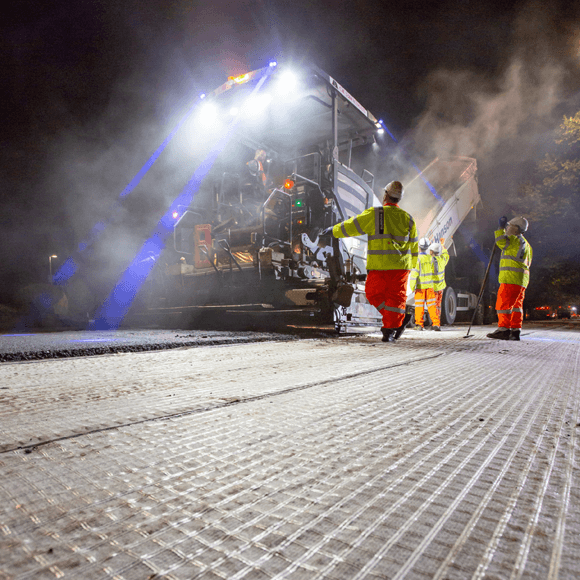
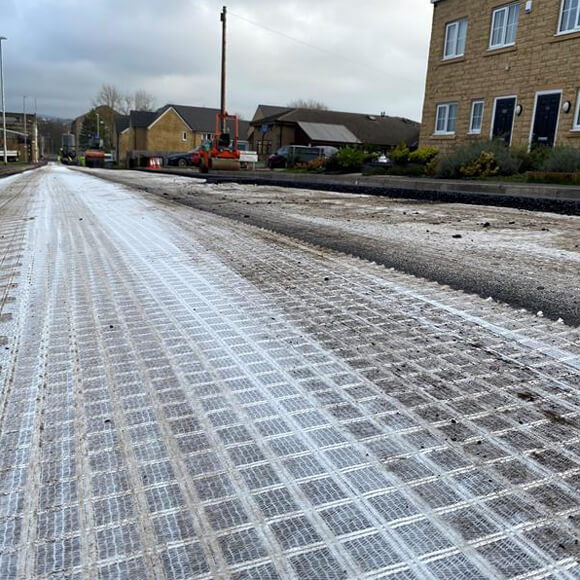
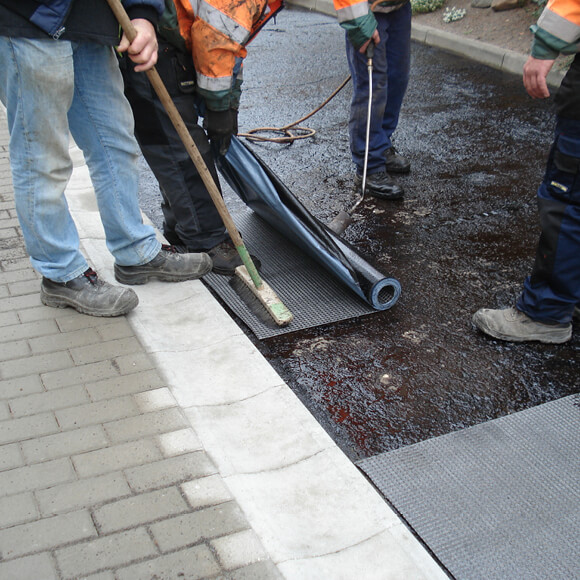
Asphalt interlayers are material solutions designed to improve the quality, performance and durability of roads and pavements. An interlayer is placed between two layers of asphalt, preventing (reflective) cracking, moisture ingress and absorbing stresses.
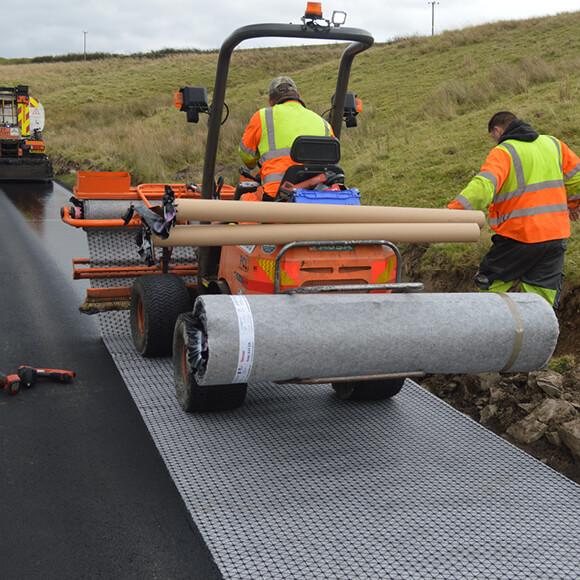
Tensar has a range of asphalt reinforcement geogrids and interlayers, designed to interact with the bitumen bound layer. These products add tensile stiffness, limit strains and reduce crack development and size. Composite interlayers comprise a geogrid bonded to a fabric and together they provide reinforcement and act as a Stress Absorbing Membrane Interlayer (SAMI) and a moisture barrier.
What causes asphalt cracking?
Asphalt cracking can grow from existing cracks or joints in the substrate (reflective cracking). It can also be induced by thermal movement of substrates, or expansion and shrinkage of subsoils. Excessive flexing of the pavement under traffic loading can also lead to fatigue cracking in the asphalt. For more information, see our guide on types of road cracks and how to avoid them.
How does an asphalt interlayer help?
Asphalt interlayers can provide a barrier to moisture ingress and also offer stress relief and reinforcement, to control cracking in the asphalt surfacing. Reinforcing asphalt interlayers can also improve pavement life by delaying the onset and propagation of fatigue cracking.
What are the functions of an interlayer?
Asphalt interlayers provide a number of different functions that reduce and prevent cracking:
- A barrier: to prevent the ingress of moisture
- Stress relief: to allow some movement between layers and thus relieve stress build-up
- Reinforcement: to provide tensile strength and stiffness to an asphalt layer.
What are the types of asphalt interlayers?
We offer different types of asphalt products that perform various interlayer functions.
- Asphalt paving fabrics are designed to absorb bitumen from the installation process, providing a barrier and stress relief functions: There are different forms of paving fabric, the most common being made from non-woven polypropylene yarn.
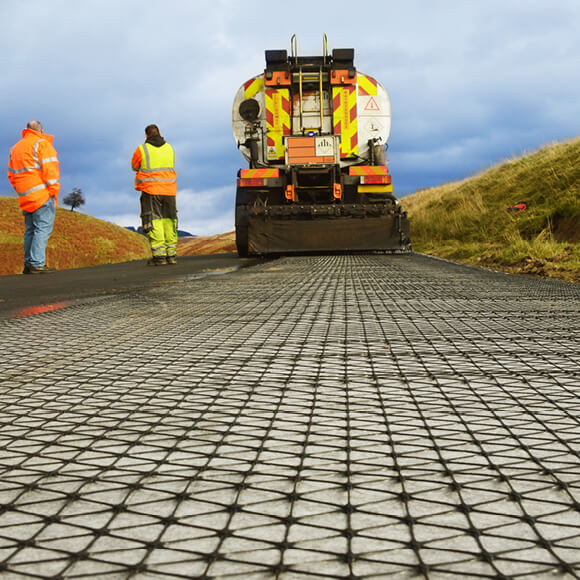
- Asphalt grid interlayers have open apertures to allow bonding of the overlay to the substrate. The grid structure is typically coated in woven glass fibre.
- Structural grid types have a higher rib profile to enable interlock between the overlay and the grid. The grid is typically a polypropylene structure with integral junctions.
- Composite interlayers combine a paving fabric with a grid or structural grid to offer multiple functionality.
How does Tensar compare with the competition?
Tensar's Foundation and Embankment products are proven, high-performance solutions that offer significant benefits over alternative asphalt reinforcement solutions.
.png "snippet-polymer-interlayers-250-250-(1).png")
Alternative Polymer Interlayers
- Typically, suppliers offer a single product type for multiple problems.
- Often generic products sourced from non-specialist manufacturers.
- Performance claims often based on generic product data. Typically no product specific design parameters available

Tensar Asphalt Interlayers
- Tensar offers a full range of products designed to tackle most flexible pavement cracking issues – paving fabrics, reinforcing grids and composites.
- Over 35 years of asphalt reinforcement experience worldwide with products that have a long and proven history or performance
- Product performance proven and quantified by research and field trials. Unique design parameters developed for use in pavement design
.png "snippet-twisted-wire-250-250-(1).png")
Twisted Wire Asphalt Reinforcement
- Difficult and complex to install with nailed fixings required. Unable to handle minor curves or undulations
- Typically, a single product type. Not suited to all asphalt cracking problems.
- Not accepted by all road authorities

Tensar Asphalt Interlayers
- Fast and simple to install either manually or by specialist equipment. Usually rolled out over sprayed tack/bond coat before overlaying with asphalt
- Tensar offers a full range of products designed to tackle most flexible pavement cracking issues – paving fabrics, reinforcing grids and composites.
- Widely used and accepted by Road Authorities worldwide
.png "snippet-mill-and-fill-250-250-(1).png")
Traditional Mill & Fill Overlay
- Cracks propagate upward from cracks or joints in the substrate – greatly reducing the life of an overlay
- Water ingress through cracked asphalt surfacing penetrates to lower pavement layers leading to degradation and increasing freeze thaw problems
- Under the action of traffic, fatigue cracks can initiate at the base of re asphalt and propagate upwards, reducing layer stiffness and shortening pavement life
Tensar Asphalt Interlayers
- Crack control – Tensar interlayer products stop or slow down the propagation of cracks initiated by cracked or jointed substrates
- Sealing – Tensar interlayers absorb bitumen from the tack/bond coat to create an impermeable layer to prevent ingress of water to eh lower pavement layers – prolonging pavement life
- Fatigue Improvement – Tensar interlayers absorb stresses at the base of the asphalt layer, elaying fatigue cracking and maintaining pavement stiffness.